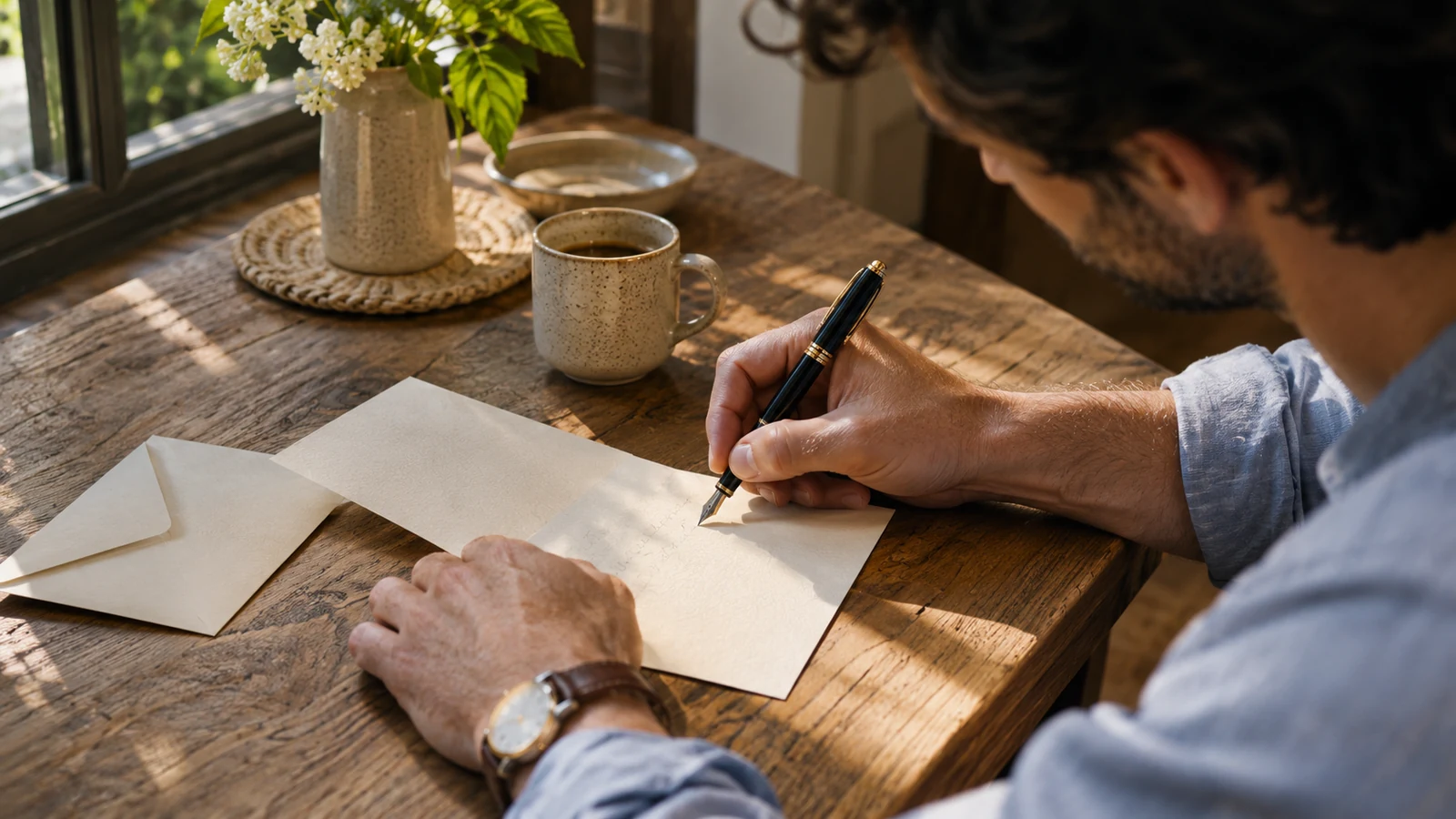
There are things worth taking the trouble to write down. A proper thank-you, a letter of sympathy, congratulations on a new child or a note to an old friend can carry more weight than a passing message sent between errands. Our parents and grandparents understood this without treating correspondence as a hobby. Writing a note was a small act of regard. You sat down, considered another person and took the trouble to put your thoughts into words. Nothing prevents us from keeping that habit now.
Choose the occasions that deserve a note
A letter is not required for every ordinary favour. A quick thank-you in person is often quite sufficient. But when someone has hosted you generously, helped you through a difficult period, opened a professional door or sent a particularly thoughtful gift, a written note is a fine way to acknowledge the effort.
Likewise, a few words after a bereavement or a major life event can be kept and reread in a way an offhand message rarely is. A thoughtful note marks the occasion without making an exhibition of the writer. Its purpose is to honour the recipient.
Write as you would speak, at your best
The greatest mistake is to confuse sincerity with elaborate language. There is no need to begin with grand declarations or borrow expressions you would never use aloud. Address the person by name, mention what you are writing about and say why it mattered. “Thank you for having us for supper on Saturday. We particularly enjoyed meeting your parents, and you made the evening a pleasure” says a great deal in a few lines.
A note becomes more convincing with a specific memory. Mention the conversation you enjoyed, the help that made a difference or the kindness which arrived at exactly the right time. Generic praise may be polite, but a detail tells the reader that you were paying attention.
Make your thanks prompt
A handwritten note need not arrive the morning after the event, but it should not be forgotten for weeks. Put a card and an envelope somewhere convenient. If someone has invited you to his home, a note sent within several days is a handsome courtesy. The same applies to thanking someone for a present or an introduction.
A delayed sincere note is still better than none. If time has passed, do not devote half the paper to apologies. Thank the person, make the point and leave the page with something worth receiving.
Show particular care with sympathy
When someone is grieving, the temptation to find the perfect phrase often leads to awkward clichés. You do not need to explain a loss or offer a lesson about how life works. Write simply. “I was very sorry to hear about your father. He always made me welcome, and I remember his kindness” is a human and dignified message.
If you can offer practical help, be specific and make only an offer you can fulfil. There is no requirement to fill the card with advice. The bereaved person should not feel obliged to write back or comfort you. Your words should make a difficult day a little less lonely.
Give the letter a little physical care
You do not need expensive stationery, a fountain pen collection or a seal. A clean card, legible handwriting and the correct name and address are enough. Check the spelling of names. If your handwriting is difficult to read, slow down or write a neatly printed note. A card enclosed in a proper envelope is more pleasant than a torn sheet of paper pulled from a notebook.
For formal thanks or condolences, avoid jokes and unnecessary decoration. Simple presentation keeps the attention on the words. The old standard was never about displaying one’s stationery. It was about demonstrating care.
Remember that a letter can preserve a friendship
Some notes have no occasion beyond the wish to remain in touch. An elderly relative may be delighted to hear what you have been doing. A former teacher may welcome news of a student who has made good use of his guidance. A friend who lives far away may appreciate a letter that asks a proper question and invites a proper answer.
Technology makes it easier to contact people, but ease does not guarantee thought. You may still choose email or a message when that suits the relationship. The courtesy lies in the care taken, not in insisting that every word travel by post.
Write something worth keeping.
A good note is prompt, specific and sincere. It gives the other person evidence that his generosity, company or friendship was noticed and valued.