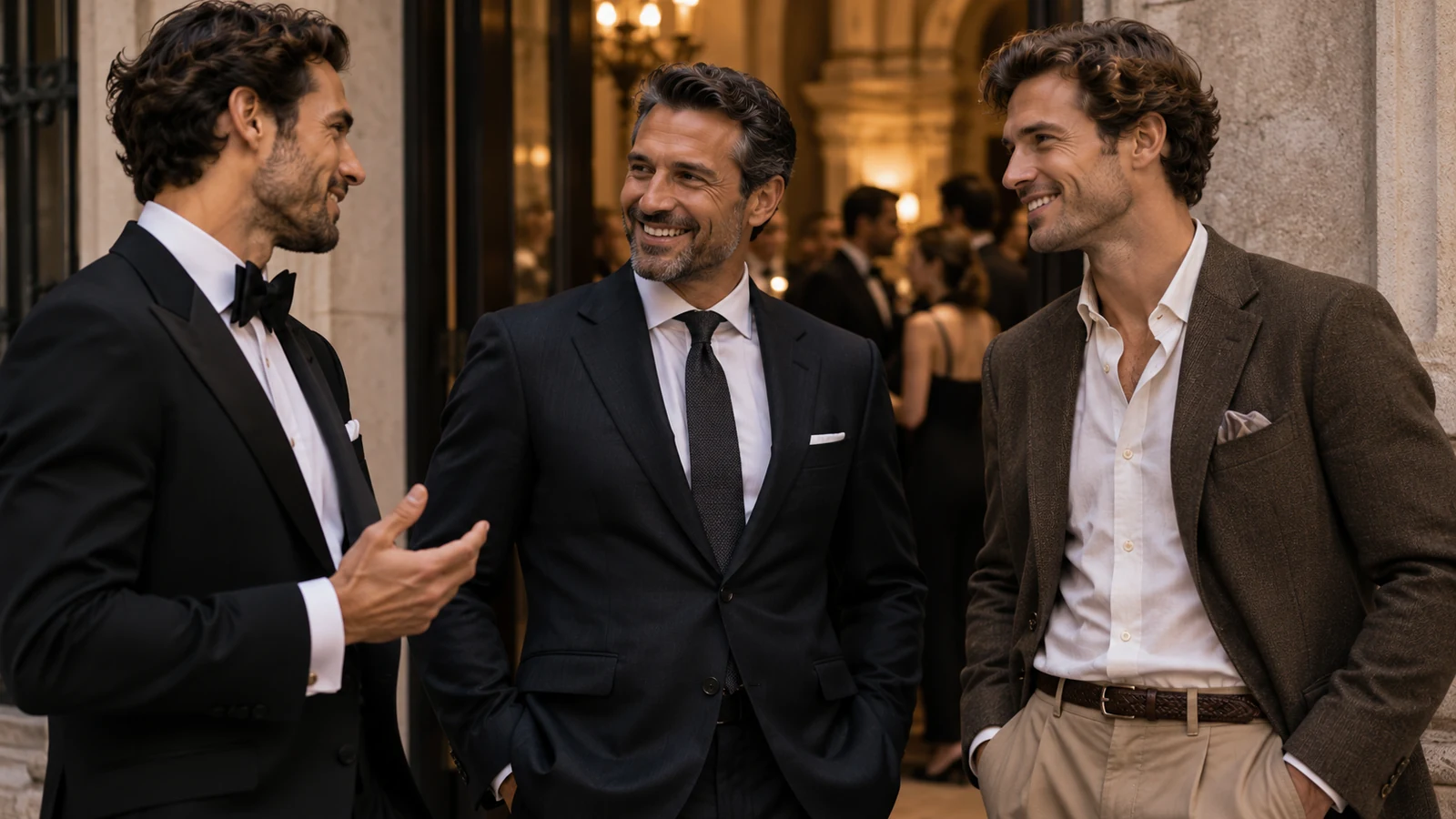
A gentleman does not dress well merely to be admired. He dresses appropriately because the occasion, and the people who have arranged it, deserve consideration. Our fathers and grandfathers understood the difference between clothes for work, for church, for dinner and for a wedding. The rules have grown less rigid, but the principle has not vanished. When an invitation sets a standard, knowing how to meet it is a courtesy. When it says nothing, sound judgement should do the work of a printed dress code.
Begin with the occasion
Before reaching for a jacket, think about where you are going, who is hosting and what others will reasonably expect. A wedding in a grand hotel is not the same as a garden lunch. A job interview deserves more care than a Saturday spent running errands. It is often easier to remove a tie or take off a jacket than to make a casual outfit respectable after arriving.
An invitation may give you useful clues even when it says little. Note the venue, the hour and the formality of the event. If you are uncertain, ask the host briefly and privately. A considerate enquiry is better than treating uncertainty as permission to appear in whatever happens to be nearest the bedroom door.
Black tie is a specific request
When an invitation says black tie, it does not mean a black business suit or a dark shirt. The traditional arrangement is a dinner jacket with matching trousers, a white evening shirt, a black bow tie and suitable black shoes. A midnight-blue dinner suit is also well established. A waistcoat or cummerbund may complete the outfit, depending on the jacket and occasion.
Do not improvise a tuxedo with novelty accessories simply to be noticed. If you do not own evening clothes and the invitation is genuinely formal, a well-fitted hire suit is a perfectly respectable solution. The important thing is to meet the occasion correctly, not to suggest that it ought to have been organised around your wardrobe.
Business formal and ordinary business dress
A dark navy or charcoal suit, an appropriate shirt, a restrained tie and clean leather shoes remain a dependable answer where business formal is expected. The exact degree of formality differs between professions and countries, but the principle is uncomplicated. Give the impression that you take the meeting seriously.
For everyday business dress, a suit may no longer be necessary. A well-fitting jacket with tailored trousers, or a pressed shirt with good trousers, may suit the office better. Observe those who carry responsibility in the environment rather than simply copying the most casually dressed person. The fact that something is permitted does not always make it the best choice.
Understand smart casual without turning it into guesswork
Smart casual is perhaps the most abused expression in modern dress. It generally asks for clothes that are relaxed without looking careless, such as a collared shirt, a neat knit, chinos or well-kept dark trousers, and clean footwear suited to the setting. A jacket may be useful, especially for an evening meal.
Avoid relying on distressed clothing, oversized slogans or shoes that have clearly seen better days. Jeans can work in some smart-casual settings, but they are not automatically suitable in every restaurant or club. When in doubt, choose the more considered option. You can dress comfortably without appearing to have made no effort.
Fit and condition matter before the label
An expensive suit with sleeves too long and trousers dragging over the heels makes a poorer impression than a modest suit altered properly. Check that a jacket sits comfortably across the shoulders, that your shirt collar does not strain and that the trousers have a deliberate length. A good alterations tailor is often a wiser expense than a more fashionable brand.
Condition matters too. Press the trousers, remove lint, polish the shoes and check for missing buttons. An immaculate pair of shoes will not rescue an outfit that is wrong for the occasion, but untidy shoes can spoil one that is otherwise correct. Looking after your clothes is part of dressing well.
Avoid making somebody else feel improperly dressed
The worst use of dress knowledge is to embarrass another guest. If a friend has misunderstood an invitation and there is still time to help, do so privately and kindly. At the event itself, do not point out a misplaced pocket square or announce that a man has worn the wrong shoes.
The point of good dress is not to make other people uncomfortable. It is to move through an occasion with confidence, show respect to your host and then give your attention to the people around you. The finest-dressed gentleman in the room should never need to tell anyone so.
Dress for the room, not for applause.
Learn the conventions, read the invitation, take care of the details and leave other people at ease. That is better style than any loudly announced fashion opinion.